Where Is AI on the P&L? Why CFOs Can’t See It Yet
Eyal Brosh asked the room in Austin to guess what a six-word question costs: “Why did margin fall last quarter?” His team ran it through an AI assistant built the way most enterprises build them. It used 1.3 million tokens and cost about $3. Even the boldest guess in the room was too low, he said.
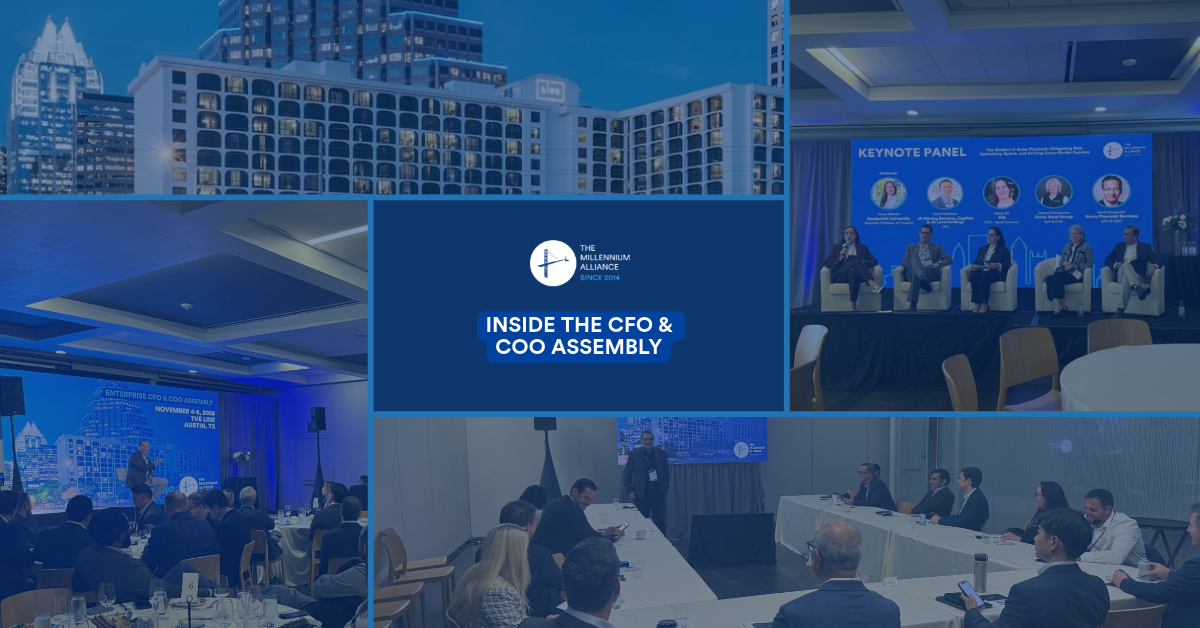
Three dollars doesn’t sound like much. That’s the problem. Multiply it across a company and AI becomes a line nobody planned for, spread across places finance doesn’t look, and paid back in ways finance can’t yet measure. That thread ran through our Transformational CFO Assembly in Austin this November.
The short answer: AI cost and AI return are both hard for finance to see. Speakers in Austin said the fix is to trace spend to the work that caused it, follow savings all the way to the P&L, and name a person who owns every automated decision.
What delegates told us before they arrived
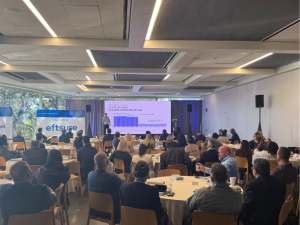
Before every Assembly, we ask registered delegates to describe their department’s objectives. For Austin, AI came up more than anything else. About half named it among their objectives. About one in three mentioned automation and process efficiency. Growth, transforming the finance function and cost reduction each came up for about one in four. Risk and controls came up least, for roughly one in twelve.
Why does a $3 question matter to finance?
Because of what Brosh, Co-Founder, COO & Chief of Engineering at Adaptive6, did next. A lean version of the same agent, with short inputs and a few tools, gave the same answer for about 20 cents. The cost came from how the agent was built, not from the question. “The question for finance isn’t whether one answer is expensive. It’s could your system trace that cost back to the question that caused it, and most can’t today,” he said.
The spend also lands somewhere new. AI, Brosh said, “doesn’t sit in an AI budget; it lands in cost of revenue, and it scales with every customer you have.” And it’s hard to stop. He cited a Deloitte CFO survey in which most CFOs said pausing an AI overrun would take days. “Several business days for something that’s billed by the second.”
The waste is quieter than that. Heidy Gil, CFO – North America at SIG, gave the audience a simple picture. “When you move on and you start investing in new things, you need to also make sure that you stop doing something else.” Otherwise, she said, “We cut cable, and then you now have 10 subscriptions.”
Why don’t the savings show up?
Dumi Martinez, CFO at JK Moving Services, has watched this happen, and not with AI. At Mars, he said, the buyers reported they were saving lots of money on cocoa and sugar. Then “when you review COGS, the value was not there.” Cash flow initiatives went the same way: “you go back and check, and the cash flow is not there.”
His fix is the clearest answer we heard to this article’s headline. The conversation, he said, had to move from value creation to value capture, which meant asking: “How do we create the specific KPIs and the tracking from end to end, so we can actually see this being reflected in a P&L or be reflected in a cash flow?”
AI adds its own leaks. Brandon Bak, Field Chief Transformation Officer at Alteryx, said teams are building faster, but “they’re spending two, three, four, five times as long and reviewing the actual outputs at the tail end.” Speed shows up on day one. The checking cost shows up later, and often not in the same budget.
Boards are asking. Oscar Munoz, former Chairman and CEO of United Airlines, sits on several. The first question he hears about any AI deployment, he said, is “Where is it on my P&L? I mean, I see the cost part of it, right?”
Who’s accountable when an agent acts?
Karthik Manimozhi, Global President, Growth and Markets at Eftsure, told a story that stuck. A finance employee in Hong Kong got a request from the UK CFO and, suspicious, asked for a video call. Everyone showed up. The employee moved 25.6 million across 15 transfers. The whole call was a deepfake.
His point wasn’t about the technology. “The fraudsters are literally exploiting the gap between your cyber security and your finance process,” he said. “This is a controls issue.” Agents widen that gap, he said, and many show up in company systems nobody authorized. “Who’s checking them?” Agents can execute, initiate and escalate to a human, he said, and “You are, in the end, accountable.”
That makes the review step a finance job. Someone has to own the check on an automated payment or output before it’s treated as true. Olesya Afanasyeva, SVP & CFO at Orion Steel Group, put the risk in a line. Earlier systems produced a generation that assumed “it came out of the system, so must be true.”
What can’t a model do for you?
Munoz’s gala keynote answered that with a story from the start of COVID. United’s finance team modeled the worst case they knew, 9/11, when the business went away for 40 days. Munoz asked them to run a 50% drop in revenue, then 75%. At 75%, he said, “That got dangerous and got everybody’s attention.” Within minutes, United stopped capital spending. Its CFO raised $6 billion that day.
The models were fine. What mattered was that someone pushed past the comfortable number. “But somebody has to keep pushing on that. A model is not going to do that for you.”
He had a warning for anyone about to automate. “They will accelerate anything that you put in front of them. And if your culture is good, that’s a good thing. If your culture ain’t right, it’s just going to get worse.”
What to do on Monday
Brosh’s list of questions for a FinOps lead is the most practical thing we heard. Can you show all our AI spend in one report, by team, app and person? And what does one finished task cost for our top three AI uses? Then borrow Martinez’s test. Pick one AI result you’ve already reported as a win and trace it to the P&L. If it isn’t there, you’ve found the gap while it’s small.
Anna Helmke, Assistant Professor of Finance at Vanderbilt University, moderated the panel and closed it with a question that fits all of this: “if the rules change again tomorrow, which investment would we be glad we made, and like which investment would we regret?”
Join us next
Our next Transformational CFO Assembly is in New Orleans, starting February 10, 2027, at The Fairmont. Finance leaders in healthcare can also join our Transformational CFO Healthcare Providers and Payers Assemblies in Dallas, starting December 1. Details are at mill-all.com.
About The Millennium Alliance
Founded in 2014, The Millennium Alliance is a premier technology and business advisory firm dedicated to transforming the digital enterprise. By bridging the gap between enterprise C-Suite leaders and their technology partners, we’ve become a global leader in corporate-level executive education and peer-to-peer engagement. Learn more at mill-all.com.