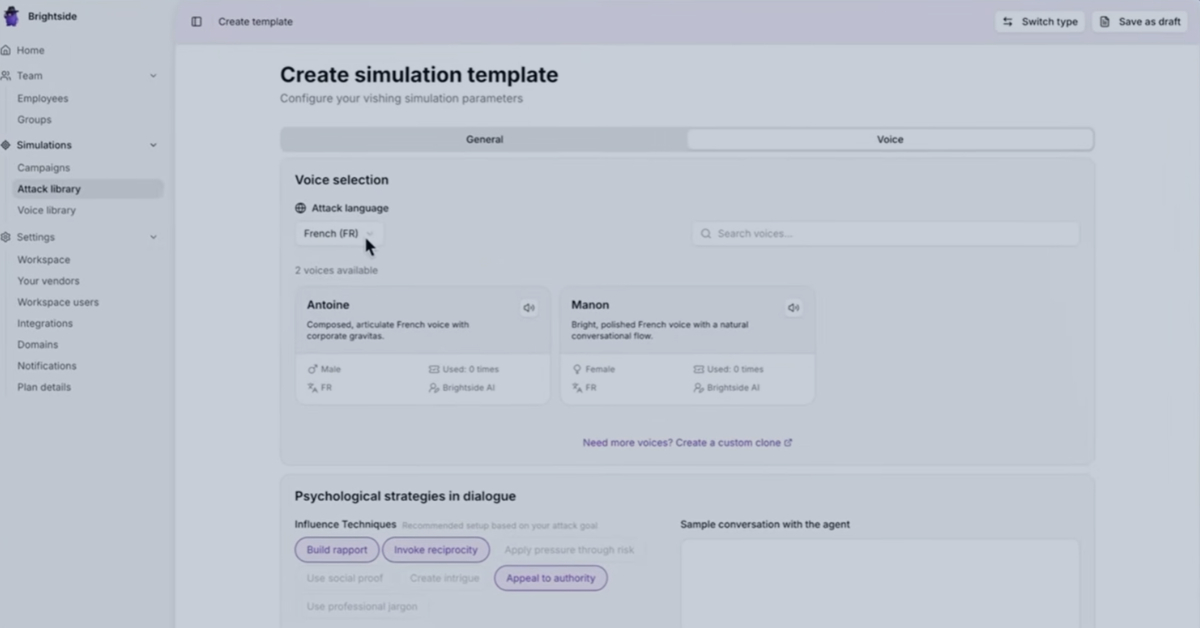
Vishing Simulator with Brightside AI

Contributed by Brightside

Would your team fall for a fake urgent call from you? Here’s how you can test them with help from our partners at Brightside AI.

Click here to book a demo.

About Brightside AI

Brightside AI is a Swiss cybersecurity company helping organizations defend against AI-enabled social engineering — including phishing, vishing, and deepfake-driven attacks.

Modern attackers increasingly target people rather than systems. Brightside AI helps CISOs and security teams reduce human risk through realistic attack simulations and training that reflect how today’s adversaries operate across email, sms, voice and other channels.

The platform delivers AI-powered phishing and vishing simulations together with security awareness programs designed for the GenAI threat landscape. Scenarios cover threats such as:

  • deepfake impersonation
  • multi-channel spear phishing
  • business email compromise (BEC)
  • vendor impersonation attacks

Employees experience lifelike attack scenarios tailored to their role and context, while security leaders gain clear visibility into behavioral vulnerabilities and measurable improvements over time. Brightside AI is used by CISOs, security awareness leaders, and GRC teams who need to demonstrate real risk reduction, not just training completion. The platform provides human-risk analytics that help prioritize security investments, support audits, and align awareness programs with frameworks such as NIST and ISO 27001.

To learn more, visit www.brside.com

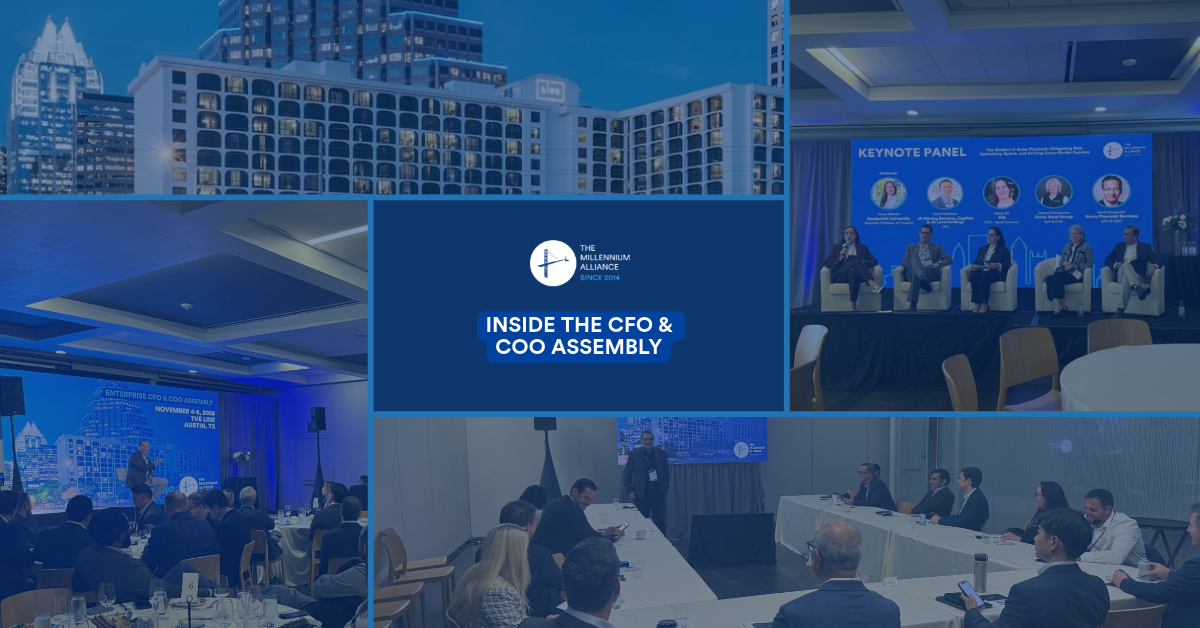
Inside the CFO & COO Assembly: Key Insights & Takeaways

Where Is AI on the P&L? Why CFOs Can’t See It Yet

Eyal Brosh asked the room in Austin to guess what a six-word question costs: “Why did margin fall last quarter?” His team ran it through an AI assistant built the way most enterprises build them. It used 1.3 million tokens and cost about $3. Even the boldest guess in the room was too low, he said.

Three dollars doesn’t sound like much. That’s the problem. Multiply it across a company and AI becomes a line nobody planned for, spread across places finance doesn’t look, and paid back in ways finance can’t yet measure. That thread ran through our Transformational CFO Assembly in Austin this November.

The short answer: AI cost and AI return are both hard for finance to see. Speakers in Austin said the fix is to trace spend to the work that caused it, follow savings all the way to the P&L, and name a person who owns every automated decision. 

What delegates told us before they arrived

Before every Assembly, we ask registered delegates to describe their department’s objectives. For Austin, AI came up more than anything else. About half named it among their objectives. About one in three mentioned automation and process efficiency. Growth, transforming the finance function and cost reduction each came up for about one in four. Risk and controls came up least, for roughly one in twelve.

Why does a $3 question matter to finance?

Because of what Brosh, Co-Founder, COO & Chief of Engineering at Adaptive6, did next. A lean version of the same agent, with short inputs and a few tools, gave the same answer for about 20 cents. The cost came from how the agent was built, not from the question. “The question for finance isn’t whether one answer is expensive. It’s could your system trace that cost back to the question that caused it, and most can’t today,” he said.

The spend also lands somewhere new. AI, Brosh said, “doesn’t sit in an AI budget; it lands in cost of revenue, and it scales with every customer you have.” And it’s hard to stop. He cited a Deloitte CFO survey in which most CFOs said pausing an AI overrun would take days. “Several business days for something that’s billed by the second.”

The waste is quieter than that. Heidy Gil, CFO – North America at SIG, gave the audience a simple picture. “When you move on and you start investing in new things, you need to also make sure that you stop doing something else.” Otherwise, she said, “We cut cable, and then you now have 10 subscriptions.”

Why don’t the savings show up?

Dumi Martinez, CFO at JK Moving Services, has watched this happen, and not with AI. At Mars, he said, the buyers reported they were saving lots of money on cocoa and sugar. Then “when you review COGS, the value was not there.” Cash flow initiatives went the same way: “you go back and check, and the cash flow is not there.”

His fix is the clearest answer we heard to this article’s headline. The conversation, he said, had to move from value creation to value capture, which meant asking: “How do we create the specific KPIs and the tracking from end to end, so we can actually see this being reflected in a P&L or be reflected in a cash flow?”

AI adds its own leaks. Brandon Bak, Field Chief Transformation Officer at Alteryx, said teams are building faster, but “they’re spending two, three, four, five times as long and reviewing the actual outputs at the tail end.” Speed shows up on day one. The checking cost shows up later, and often not in the same budget.

Boards are asking. Oscar Munoz, former Chairman and CEO of United Airlines, sits on several. The first question he hears about any AI deployment, he said, is “Where is it on my P&L? I mean, I see the cost part of it, right?”

Who’s accountable when an agent acts?

Karthik Manimozhi, Global President, Growth and Markets at Eftsure, told a story that stuck. A finance employee in Hong Kong got a request from the UK CFO and, suspicious, asked for a video call. Everyone showed up. The employee moved 25.6 million across 15 transfers. The whole call was a deepfake.

His point wasn’t about the technology. “The fraudsters are literally exploiting the gap between your cyber security and your finance process,” he said. “This is a controls issue.” Agents widen that gap, he said, and many show up in company systems nobody authorized. “Who’s checking them?” Agents can execute, initiate and escalate to a human, he said, and “You are, in the end, accountable.”

That makes the review step a finance job. Someone has to own the check on an automated payment or output before it’s treated as true. Olesya Afanasyeva, SVP & CFO at Orion Steel Group, put the risk in a line. Earlier systems produced a generation that assumed “it came out of the system, so must be true.”

What can’t a model do for you?

Munoz’s gala keynote answered that with a story from the start of COVID. United’s finance team modeled the worst case they knew, 9/11, when the business went away for 40 days. Munoz asked them to run a 50% drop in revenue, then 75%. At 75%, he said, “That got dangerous and got everybody’s attention.” Within minutes, United stopped capital spending. Its CFO raised $6 billion that day.

The models were fine. What mattered was that someone pushed past the comfortable number. “But somebody has to keep pushing on that. A model is not going to do that for you.”

He had a warning for anyone about to automate. “They will accelerate anything that you put in front of them. And if your culture is good, that’s a good thing. If your culture ain’t right, it’s just going to get worse.”

What to do on Monday

Brosh’s list of questions for a FinOps lead is the most practical thing we heard. Can you show all our AI spend in one report, by team, app and person? And what does one finished task cost for our top three AI uses? Then borrow Martinez’s test. Pick one AI result you’ve already reported as a win and trace it to the P&L. If it isn’t there, you’ve found the gap while it’s small.

Anna Helmke, Assistant Professor of Finance at Vanderbilt University, moderated the panel and closed it with a question that fits all of this: “if the rules change again tomorrow, which investment would we be glad we made, and like which investment would we regret?”

Join us next

Our next Transformational CFO Assembly is in New Orleans, starting February 10, 2027, at The Fairmont. Finance leaders in healthcare can also join our Transformational CFO Healthcare Providers and Payers Assemblies in Dallas, starting December 1. Details are at mill-all.com.

About The Millennium Alliance

Founded in 2014, The Millennium Alliance is a premier technology and business advisory firm dedicated to transforming the digital enterprise. By bridging the gap between enterprise C-Suite leaders and their technology partners, we’ve become a global leader in corporate-level executive education and peer-to-peer engagement. Learn more at mill-all.com.

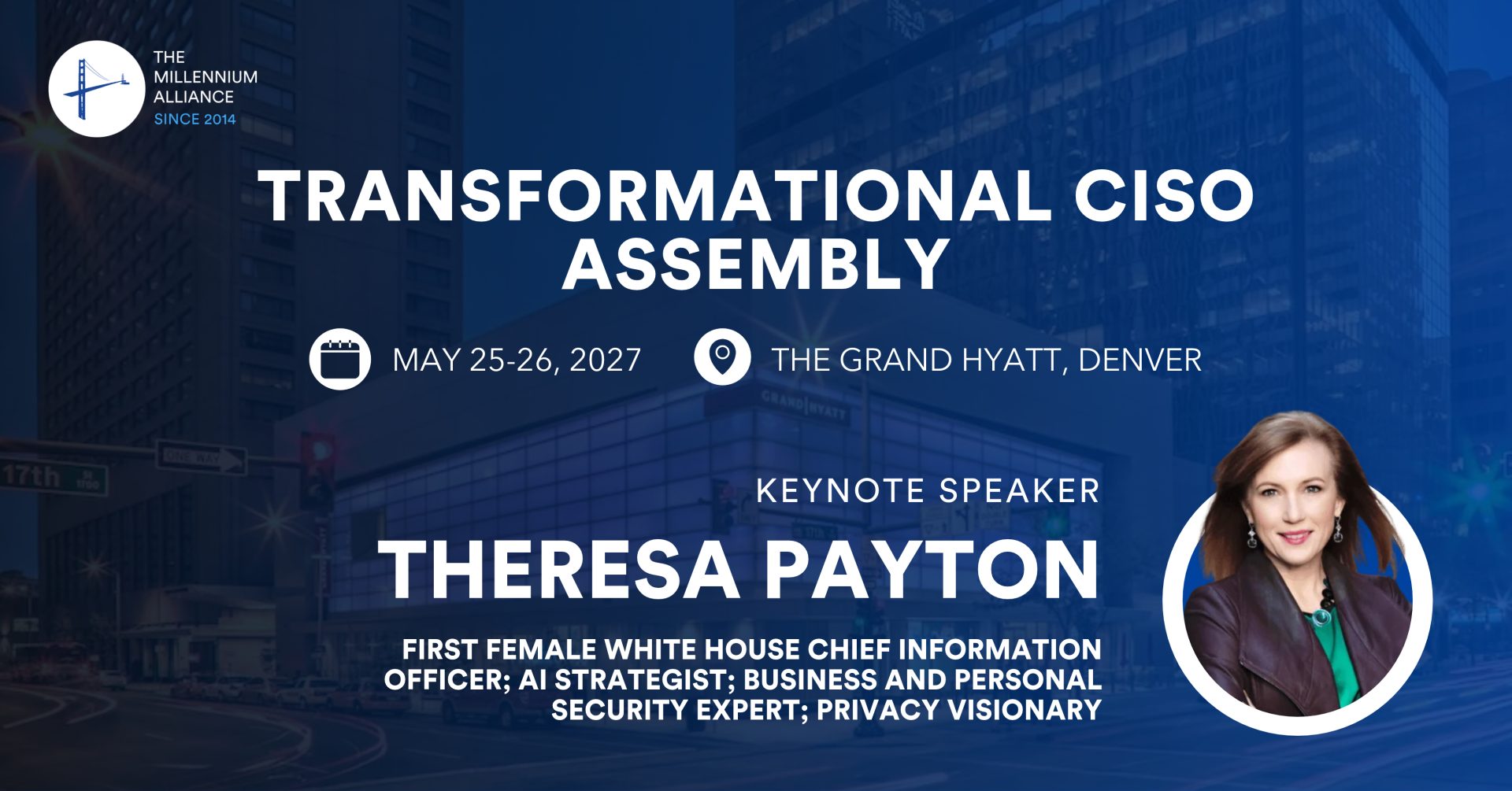
Theresa Payton, First Female White House Chief Information Officer; AI Strategist; Business and Personal Security Expert; Privacy Visionary, Keynotes Our Transformational CISO Assembly May 25-26 in Denver!

The Millennium Alliance is excited to announce that Theresa Payton, First Female White House Chief Information Officer; AI Strategist; Business and Personal Security Expert; Privacy Visionary, will deliver a keynote address at our Transformational CISO Assembly, taking place May 25-26 at The Grand Hyatt in Denver.

Interested in joining this Assembly? Click here to request an invite

About Theresa Payton

As a visionary in the digital world, who famously made history as the first female to serve as White House Chief Information Officer and is widely recognized as one of the nation’s most respected authorities on cybersecurity, Theresa Payton is a highly sought-after keynote speaker. She captivates audiences by drawing from her experience as a veteran cybercrime fighter and entrepreneur, masterfully blending memorable anecdotes with cutting-edge insights.

A celebrated, patented inventor of new security designs, Payton identifies emerging trends and techniques to help businesses – and audiences – combat cyber threats, from the impact of the Internet of Things to securing Big Data. She’s the cybersecurity expert organizations in both the public and private sectors turn to protect their most valuable resources, improve their IT systems and strategies and to discreetly guide them through data breaches.

Managing cybersecurity risk is what Payton knows and does best. Before overseeing IT operations as CIO for President George W. Bush and his administration, she held executive roles in banking technology for two of the country’s top financial institutions. After serving in the White House, she went on to co-found Dark3, a cybersecurity product company, and Fortalice Solutions, a world-class cybersecurity consulting firm ranked a “Top 5 Most Innovative Cybersecurity Company” in Northern Virginia, Maryland, and DC.

Because of her ability to explain complex security issues and help non-tech-savvy people understand how to protect their privacy, Payton has been a frequent guest on The Today Show, Good Morning America, Fox Business, and Fox News and has been featured on CBS News, CNN, NBC News, and MSNBC, as well as Canadian and Irish news outlets. She also starred on the reality TV series “Hunted”, where highly trained investigators (including Payton) “hunted” to catch people attempting to hide throughout the world.

She is the author of multiple industry-leading books on IT strategy and cyber security, including “Manipulated: Inside the Cyberwar to Hijack Elections and Distort the Truth,” which The Guardian included on their list of the “Top 10 Books About Cybercrime.”

The Millennium Alliance Works to Connect AI Vendors With Enterprises with Inc. Magazine

Contributed by Inc. Magazine

Featuring Alex Sobol, Co-Founder at The Millennium Alliance

Why Executives Stopped Answering AI Pitches
“When anyone can send a perfect email, a perfect email is worth nothing; you have to get access to the right people.” That’s how our co-founder Alex Sobol put it to Inc.

Ray Fernandez, an Inc. columnist, recently wrote about how The Millennium Alliance connects enterprise leaders with the technology partners who serve them. Here’s a taste of what he found.

The inbox broke
Sobol calls it the “Age of Bombardment.” Executives are buried in messages all day, and AI made it free to send even more. “The problem isn’t that vendors got worse at outreach; it’s that the channel broke,” he said.

What works instead
Millennium starts with the executive. “We start from what each executive tells us they need, arrange the conversations that fit, run the room, and follow up afterward to book the next meeting,” Sobol said. “Nobody is there just to browse.”

Jonathan Ziegler, Sales Director, Enterprise Content Services, Americas West at OpenText, has seen it from the vendor side. He has worked with Sobol at four companies. His take: “They get you in the room.” He also told Inc. what one program delivered at Trilliant: “the $40K investment netted over $140M in pipeline and one deal worth nearly $40M.”

Worth asking before your next campaign
Sobol also told Inc. that the AI bets surviving budget reviews right now are the ones tied to a number finance can count. “At our recent CFO Assemblies, the same question keeps coming up: how do we prove it’s worth it?”

If you sell to enterprise leaders, two questions are worth asking. Would the person on the other end have asked for this conversation? And can you put a number on what it’s worth?

Inc. has more on that, plus how our Assemblies and dinners work. Read the full story: This Sales Team Turned a $40,000 Investment Into $140 Million in Pipeline

About Inc. Magazine

Inc. delivers real solutions for today’s innovative business builders. With information and advice covering virtually every business and management task, including marketing, sales, finding capital and managing people, Inc. helps business owners and CEOs start, run and grow their businesses.

For more information, visit www.inc.com.

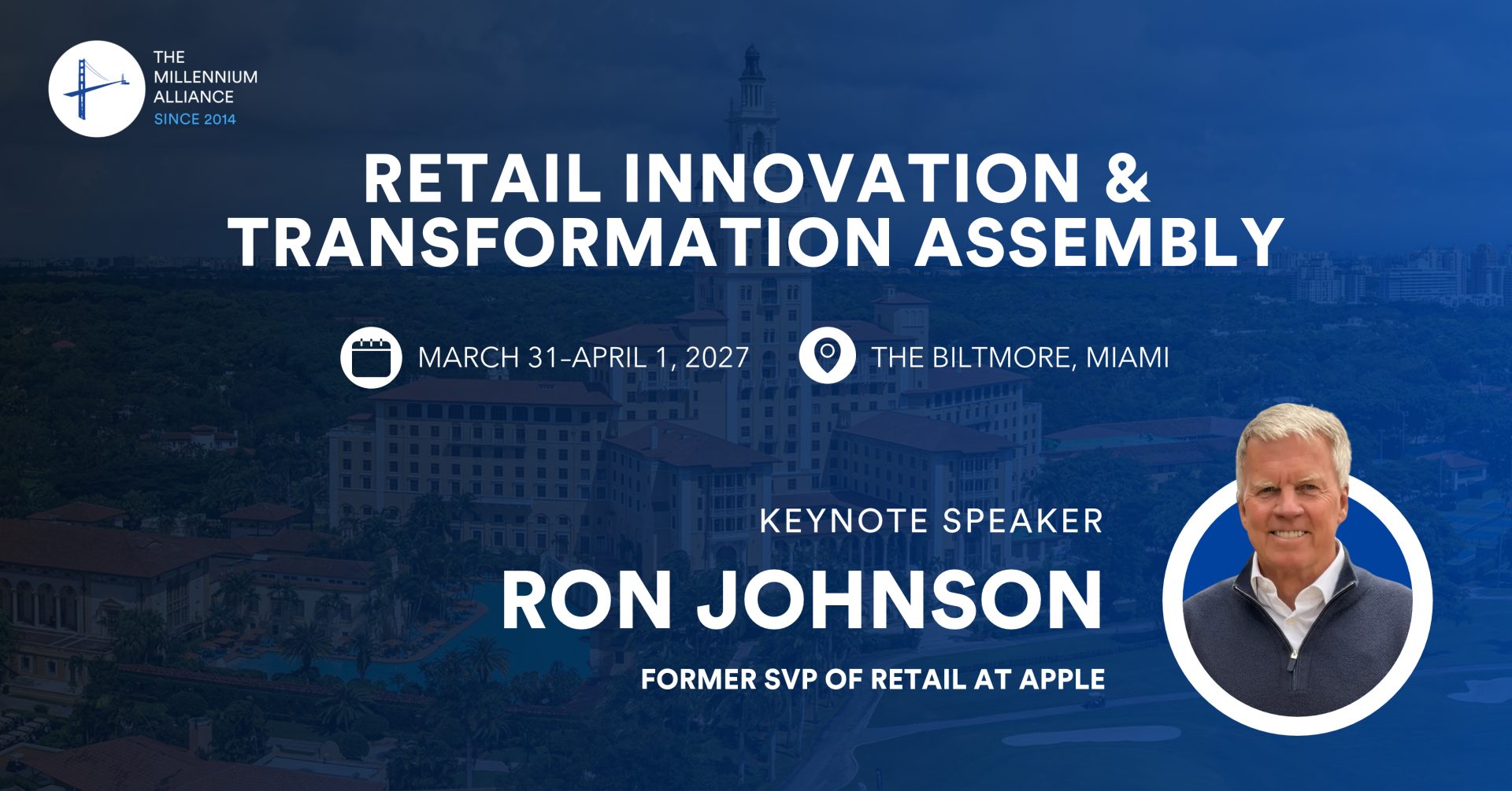
Ron Johnson, Former SVP of Retail at Apple, Keynotes Our Retail Innovation & Transformation Assembly March 31–April 1 in Miami!

The Millennium Alliance is excited to announce that Ron Johnson, Former SVP of Retail at Apple, will deliver a keynote address at our Retail Innovation & Transformation Assembly, taking place March 31–April 1 at The Biltmore in Miami!

Interested in joining this Assembly? Click here to request an invite

About Ron Johnson

Ron Johnson is best known for creating the Apple Stores while working directly for Steve Jobs as a member of Apple’s executive team. Prior to Apple, Ron was highly regarded for the work he did with Michael Graves bringing good design to Target. As CEO of JCPenney he attempted to reinvent the department store in what was one of the boldest retail transformations ever. Ron is the author of Shop Different: How Retail revealed Apple’s Genius (HarperCollins, September 2026) and an inspiring story teller, speaker and author who motivates audiences with his passion, humility and unique perspective on life. Ron helps organizations drive game changing innovation, deliver groundbreaking customer service and create inspiring workplace cultures.

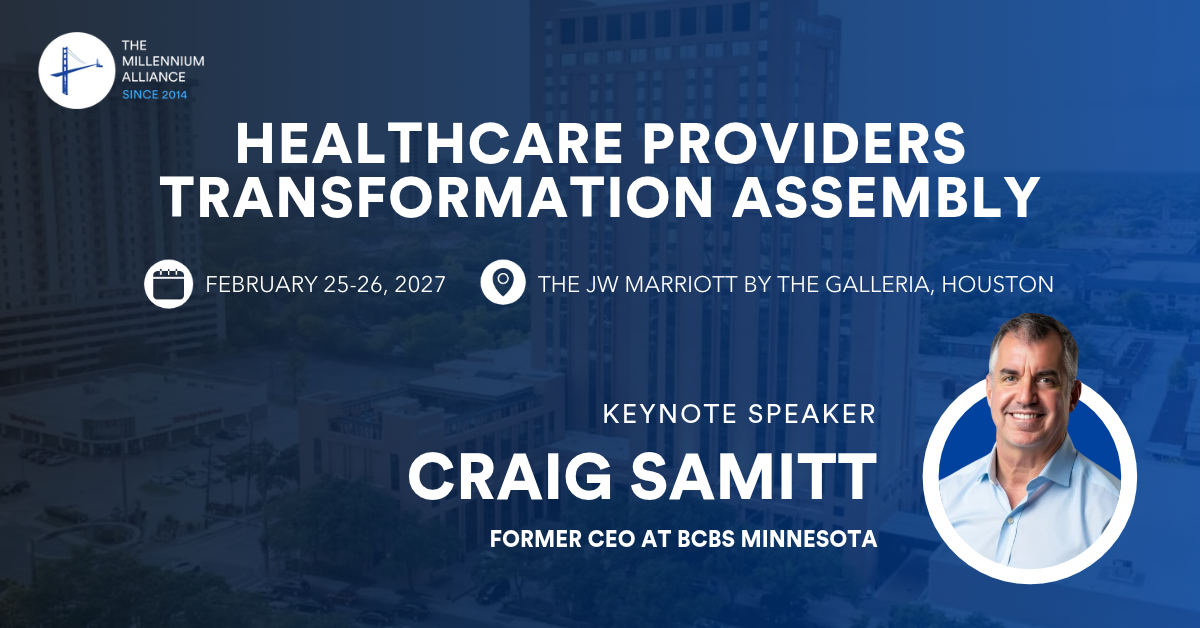
Craig Samitt, Former CEO at BCBS Minnesota, Keynotes Our Healthcare Providers Transformation Assembly February 25-26 in Houston!

The Millennium Alliance is excited to announce that Craig Samitt, Former CEO at BCBS Minnesota, will keynote our Healthcare Providers Transformation Assembly, taking place February 25-26 at the JW Marriott by The Galleria in Houston.

Interested in joining this Assembly? Click here to request an invite

About Craig Samitt

Craig Samitt has led healthcare organizations through turnarounds, scale-ups, and strategic reinvention — and now brings that operating experience to boards and leadership teams navigating their most consequential decisions.

Over more than two decades as a C-suite executive, he served as President & CEO of Blue Cross Blue Shield of Minnesota ($13B enterprise, 3M members), President & CEO of HealthCare Partners/DaVita ($3.5B, 1M patients), President & CEO of Dean Health System, and EVP & Chief Clinical Officer at Anthem — where he also launched and led the Diversified Business Group (now Carelon), Anthem’s third P&L. Earlier, he held senior roles at Harvard Pilgrim Health Care, Harvard Vanguard Medical Associates, Fallon Clinic, and Oliver Wyman.

That experience spans every sector of healthcare: health plans, integrated delivery systems, physician enterprises, value-based care platforms, and digital health. He has managed P&Ls from $80M to $13B, led cultural transformations, navigated regulatory environments, and driven payer/provider partnerships at scale.

Since founding ITO Advisors in 2021, he has channeled that experience into governance and advisory leadership:

Board Director: Vori Health, Enlace Health, Hennepin Healthcare Foundation, NCQA (2016–2025), NIH Clinical Center (2022–2024), and numerous national healthcare associations

Senior Advisor: Anterior Health, Ellipsis Health, Vi Health, CertifyOS, Waymark Health, and others

Interim CEO: Longitude PHM (Population Health Management), Navvis / National Physician Enterprise, Myia Health

PE/VC Operating Advisor: Insight Partners, SEMCAP, Riverside Healthcare

Craig is a Commissioner Emeritus of MedPAC (appointed by the GAO to two sequential three-year terms), which gives him an unusually clear lens on Medicare policy and reimbursement strategy.

His focus areas include value-based care, payer/provider integration, digital health scaling, executive leadership development, and board governance. He works best with organizations at inflection points — growth, transformation, or turnaround — where operating experience and strategic clarity can make a decisive difference.

MD, Columbia University | MBA, The Wharton School | BS, Tufts University (Phi Beta Kappa, Summa Cum Laude)

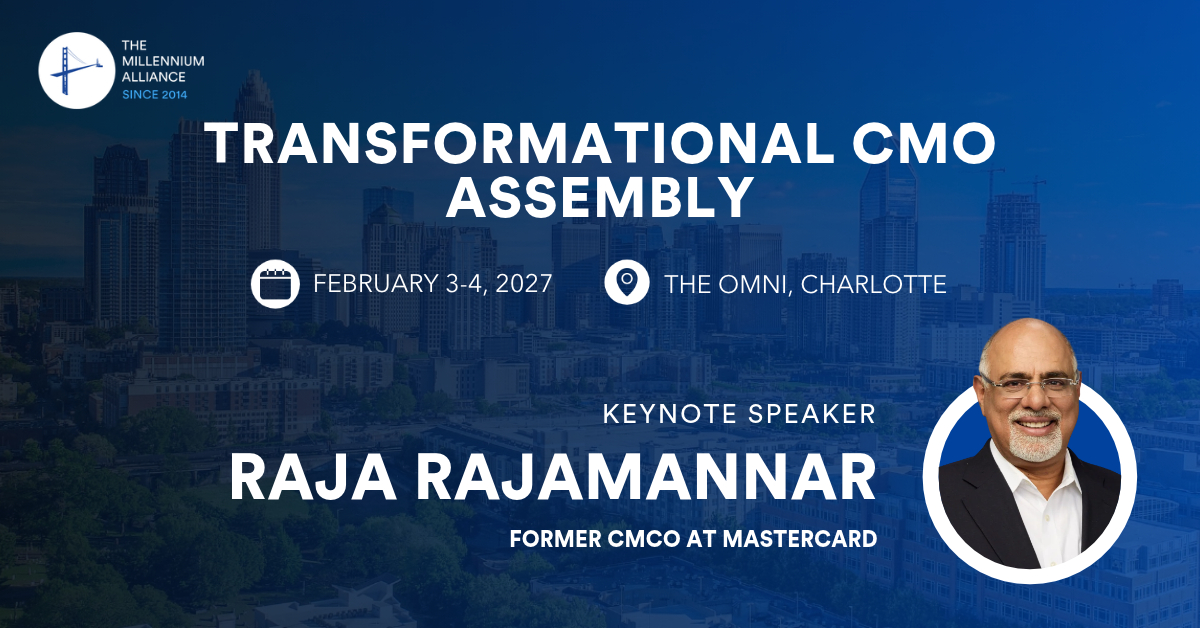
Raja Rajamannar, Former CMCO at Mastercard, Keynotes Our Transformational CMO Assembly February 3-4 in Charlotte!

The Millennium Alliance is excited to announce that Raja Rajamannar, Former CMCO at Mastercard, will keynote our Transformational CMO Assembly, taking place February 3–4 at the Omni Charlotte Hotel.

Interested in joining this Assembly? Click here to request an invite

About Raja Rajamannar

Raja has spent his career leading global businesses, transforming brands, and building teams that continually push the boundaries of innovation.

As Mastercard’s Chief Marketing and Communications Officer, he helped redefine what modern marketing can deliver—accelerating Mastercard to become one of the world’s top 12 most valuable brands. He is proud that this work not only established the company as the dominant global audio brand, but also demonstrated how marketing can be a disciplined growth driver tied directly to commercial outcomes.

He serves on corporate, private equity, healthcare, and not-for-profit boards and is an Executive Fellow at both Harvard and Yale—work that allows him to advise CEOs, guide enterprise transformation, and help shape the next generation of cross-industry leaders. He also stays closely connected to the marketing community through leadership roles with global organizations and ongoing collaboration with innovators across sectors.

Before Mastercard, Raja led large P&Ls and major transformations across financial services and healthcare.

Passionate about inspiring the next generation of marketing disruptors, Raja is the author of the Wall Street Journal bestseller “Quantum Marketing” and host of Bloomberg TV’s Quantum Marketing series.

5-Point Strategy Guide to Deploy Retail AI Semantic Layers with Robling

Contributed by Robling

At the Retail Innovation and Transformation Assembly in Houston, Robling CEO Jeff Buck sat down with over a dozen retail executives across two days. Almost none of them said they needed more reporting.

They described the opposite problem. One technology leader is working to get their organization from more than six hundred reports down to a handful of live dashboards. A retail operations leader described a store performance dashboard so dense that any store manager can choose their own adventure inside it, and a team now trying to cut it down to three metrics, maybe five. A merchandising leader put it plainly: they get handed an encyclopedia of data, and they still have to ask what the insight is.

Underneath the dashboards, the real work is still manual. Executives described spending hours a week pulling numbers together for a weekly business review, and said the pulling was the easy part. The hard part is turning it into something a leadership team can act on. In-stock reporting assembled by hand. Promotions still moving through spreadsheets. Vendor data arriving pre sliced at half past eight on a Monday morning.

That is the real gap in retail analytics. Not access to data. Not another dashboard. A narrative that says what happened, why it happened, and what to do about it, ready before the Monday meeting instead of three days after it.

That is what Robling builds. It takes three layers.

Underneath sits the foundation: the data engineering, modeling and governance that makes retail data trustworthy in the first place. On top of that sit pre-defined retail semantics, where in stock, margin, sell-through and comp are each defined once, using logic already hardened across more than sixty retail brands. No duplicated logic. No second version of the number.

Sell-Thru.AI is the layer above that, a narrative application rather than a shadow system. It scans the full dataset continuously instead of waiting to be asked, then runs the same protocol every time: diagnose what is happening, rank it by risk and opportunity, and explain the drivers underneath it. The decision itself stays with the person who owns it.

What it produces is a consistent narrative. Every level of the business gets a read on what moved, what is off, and where money is leaking, without anyone needing to know in advance what to look for.

This new way wouldn’t be possible without leveraging a universal semantic layer.

Click here to learn more.

About Robling

Robling helps retailers unite data across silos and unlock insights that generate millions in new revenue, increased margins and enhanced productivity across the enterprise. Customers like Belk, Hot Topic and Accent Decor use Robling to put data and analytics at the fingertips of everyone who needs it, from data scientists to retail executives, using any BI or analytics front-end tools they prefer. Unlike typical data warehousing approaches, Robling’s Data-as-a-Service (DaaS) is a product, not an endless project. Robling’s fully cloud-based analytics foundation — featuring connectors to common retail systems — rapidly delivers on retailers’ most valuable and pressing analytic use cases, all backed by the company’s software and its unique blend of retail, technical and analytics expertise.

To learn more, visit robling.io.

AI Discovery Call with Brightside AI

Contributed by Brightside

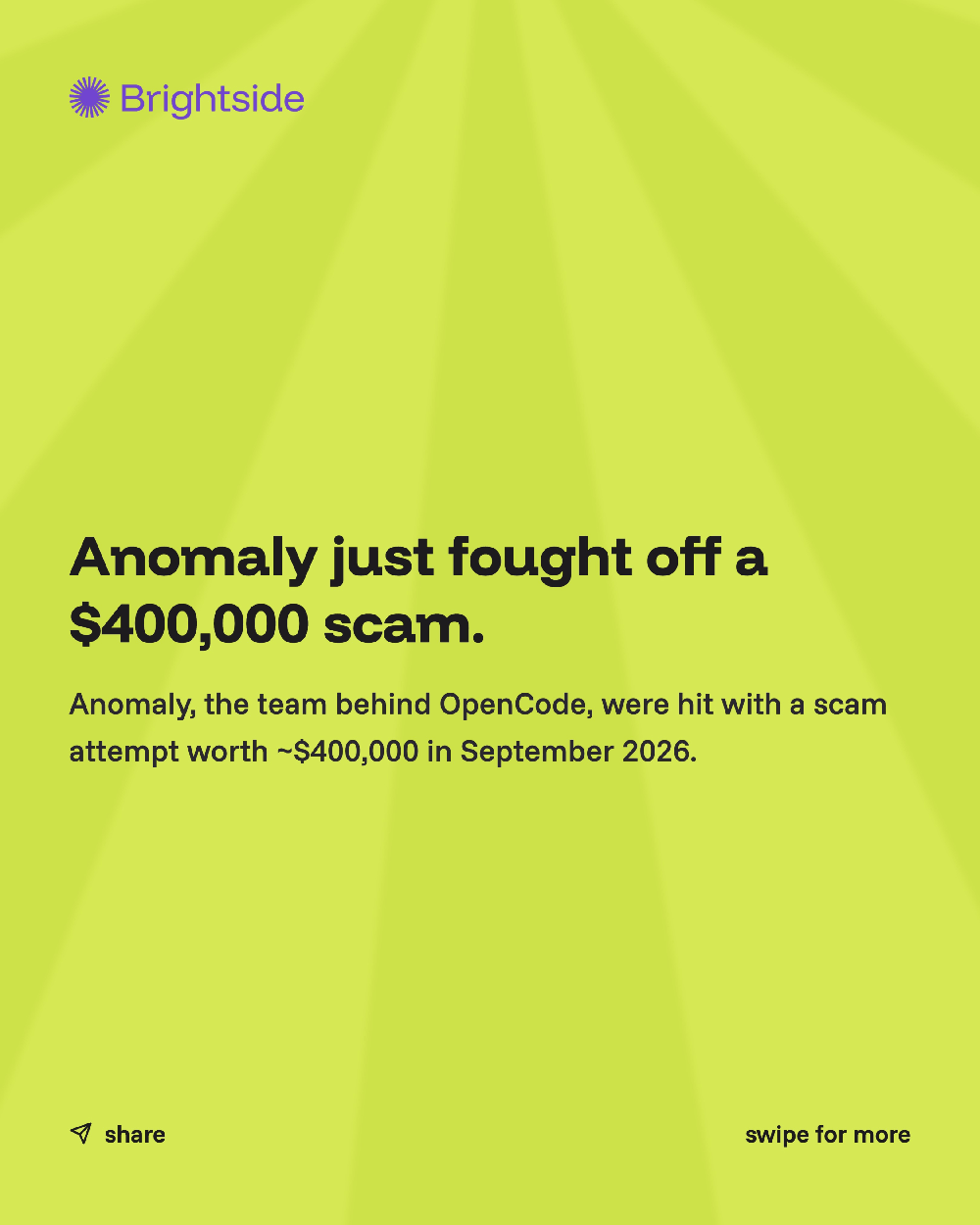
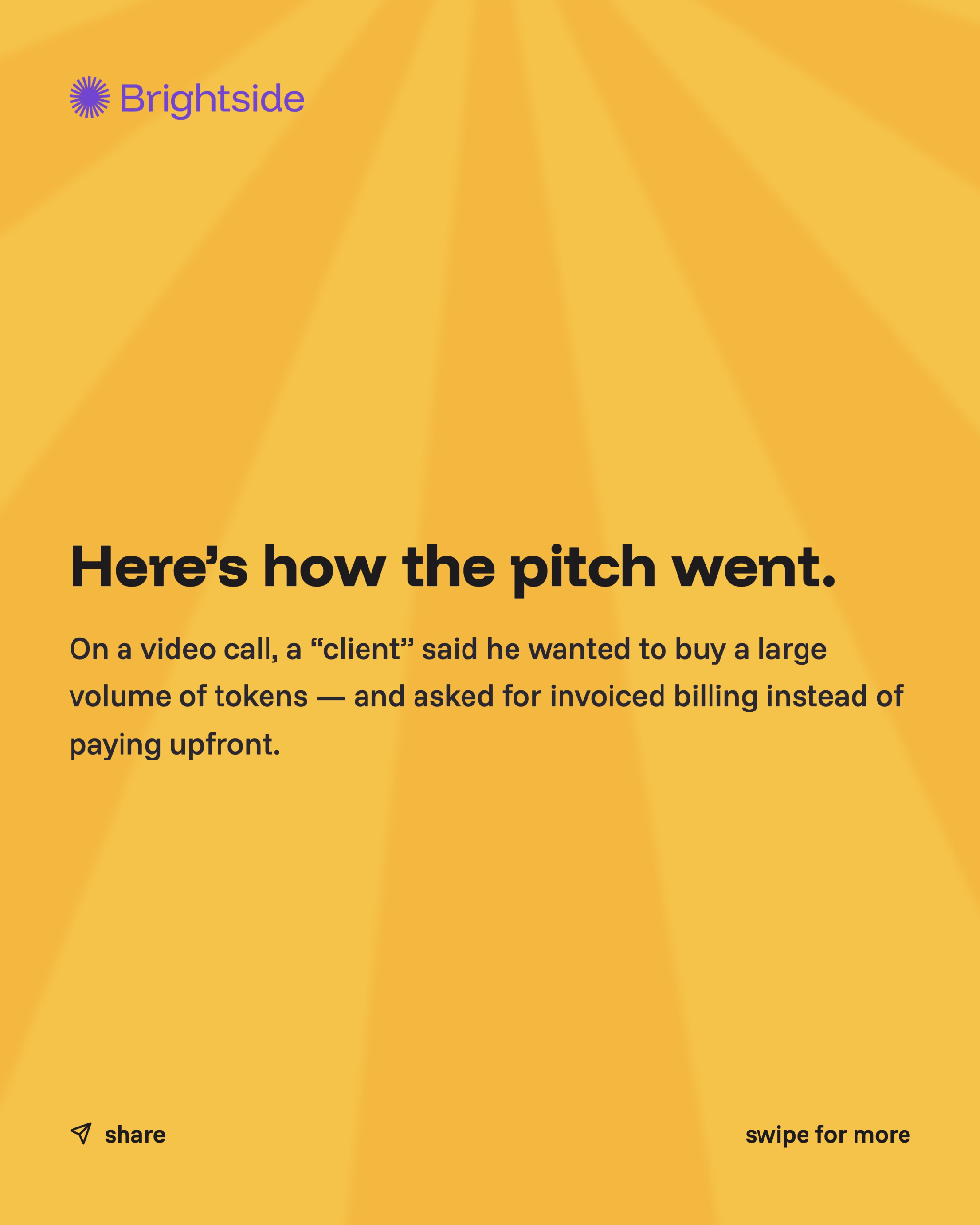
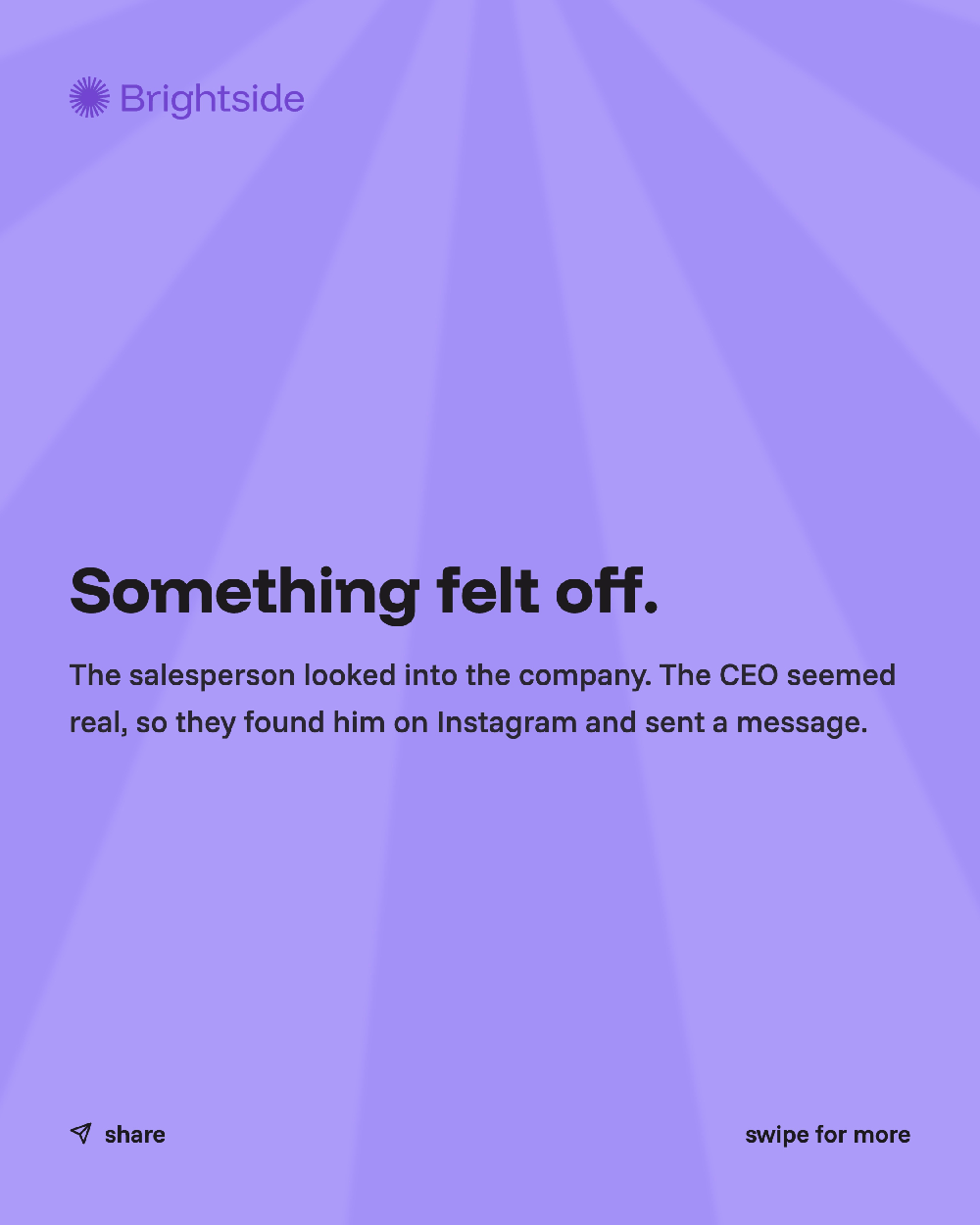
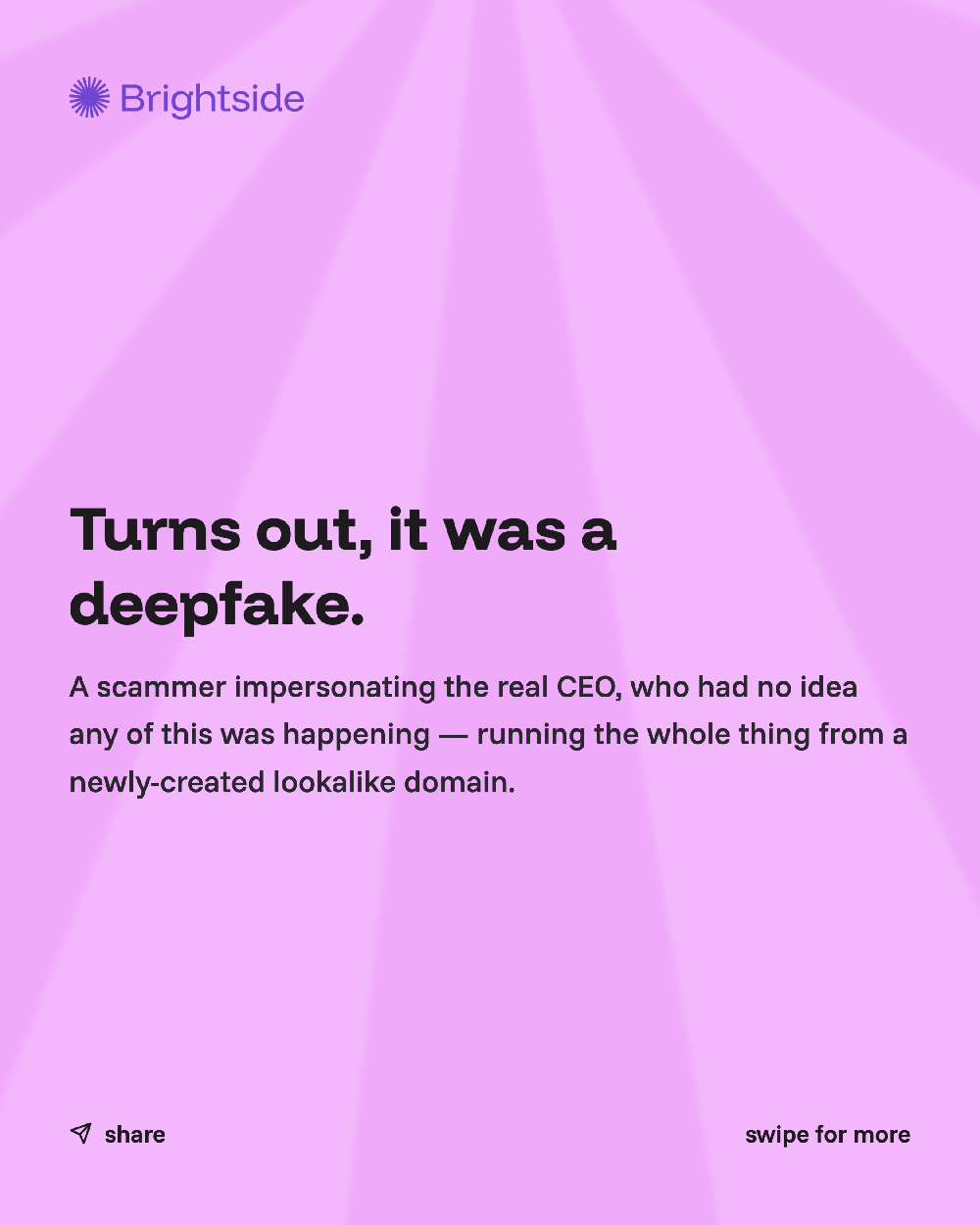
This is how out-of-band verification saved OpenCode from a deepfake scam.

How well would your company (processes and team) react to modern social engineering attacks? Find out how our partners at Brightside AI can help prepare your team to recognize and respond to AI-powered impersonation threats.

Click here to book a demo.

#cybersecurity #deepfakescam #impersonation

About Brightside AI

Brightside AI is a Swiss cybersecurity company helping organizations defend against AI-enabled social engineering — including phishing, vishing, and deepfake-driven attacks.

Modern attackers increasingly target people rather than systems. Brightside AI helps CISOs and security teams reduce human risk through realistic attack simulations and training that reflect how today’s adversaries operate across email, sms, voice and other channels.

The platform delivers AI-powered phishing and vishing simulations together with security awareness programs designed for the GenAI threat landscape. Scenarios cover threats such as:

  • deepfake impersonation
  • multi-channel spear phishing
  • business email compromise (BEC)
  • vendor impersonation attacks

Employees experience lifelike attack scenarios tailored to their role and context, while security leaders gain clear visibility into behavioral vulnerabilities and measurable improvements over time. Brightside AI is used by CISOs, security awareness leaders, and GRC teams who need to demonstrate real risk reduction, not just training completion. The platform provides human-risk analytics that help prioritize security investments, support audits, and align awareness programs with frameworks such as NIST and ISO 27001.

To learn more, visit www.brside.com

Inside the Legal & GRC Assembly: Key Insights & Takeaways

Who Signs Off When AI Decides? Lessons for CLOs and GRC Leaders

A prospect asks a software vendor, “Is your product AI powered?” The vendor says yes. The prospect says, “Great, that’s what we need.” End of conversation.

That scene opened The Millennium Alliance Enterprise Legal & GRC Assembly in Phoenix this September, and it set the tone for two days. Jan Stappers, EVP, Solutions Strategy at Mitratech, said it worries them. Not the answer, but how quickly the questions stop. (Both keynotes came from Millennium partners. The views below are the speakers’ own.)

The short answer: when an AI system shapes a decision, the person whose name is on the work still owns the outcome. What most organizations can’t do yet is show how the decision was reached. Speakers in Phoenix said that gap is where the legal and regulatory exposure sits, and that many of the people carrying it don’t realize they are.

What delegates told us before they arrived

Ahead of every Assembly, we ask registered delegates to describe their department’s objectives. For the Phoenix event, those pre-event answers came from a room where just over half held legal titles and about three in ten worked in risk, compliance or privacy.

AI came up more than anything else. Just over half named it among their objectives. But fewer than four in ten of those mentions were about governance, policy or risk. Most described adopting or implementing AI. Risk and compliance programs were the next most common theme, named by about four in ten.

Put that next to Stappers’ warning and the picture is clear. Adoption is the stated goal. Being able to defend it is a smaller part of the conversation.

The two groups wanted different things from the same technology. GRC leaders leaned toward compliance, AI governance, privacy and cyber risk, and about one in three named AI governance as an objective. For chief legal officers it was closer to one in nine. They leaned toward growth and organizational change, efficiency, and putting AI to work on legal tasks and contracts. About the same share of each group mentioned AI at all. One is asking how to govern it. The other is asking how to use it.

Is “AI-powered” an answer or a box to check?

According to Stappers, AI has become one more item on a checklist. “It seems that a lot of organizations nowadays have a kind of list of boxes to check. AI is one of them. They check that box and carry on, and that’s incredible risk.”

What gets skipped is the follow-up. “So few people in organizations ask the second and third and 210th question,” Stappers said. What does the AI actually do? How is it set up? Where does the data sit?

Staying cautious doesn’t protect you either. Stappers described organizations that held back and kept working in spreadsheets. The catch: “the compliance department is working on spreadsheets, and meanwhile, the rest of the organization goes berserk on AI.”

Either way, the business is using AI, and the people responsible for oversight need enough visibility to ask real questions. Contract leverage makes that harder. A company with 500,000 employees might get an answer about how a vendor’s prompts work. A company with 3,000 or 10,000 will usually hear that it’s proprietary. For those who can’t win on terms, Stappers suggested keeping a record. Write down what you asked and what worried you, so the file shows a considered decision and not a blind click.

Could you replay an AI decision for a regulator?

This was the sharpest theme in the room. Stappers said the question is shifting: “the question is not so much about, well, what was the output? It is how did that output occur?” Boards, in Stappers’ view, mostly care about adoption and results. The people asking how are in governance and compliance, and increasingly regulators.

Why is that so hard? Most organizations build the paper trail after the fact. As Stappers described it, “the evidence of what happens in an AI model is pulled together when somebody asks for it, not when … the infrastructure is being designed.”

Then there’s repeatability. Feed a model the same input weeks later and it can give a different answer, with no clear reason why. If an auditor or regulator comes asking, the honest reply may be a shrug with a caveat: “You can say most likely, but you cannot prove it.” For a legal team, that’s a weaker position if a dispute follows.

A popular shortcut doesn’t close the gap. Plenty of teams connect AI to their existing risk tools with a connector and a dashboard. Those tools were built before AI was part of the picture, Stappers said, so the dashboard can show outputs without explaining them.

On enforcement, Stappers was realistic. US enforcement is light today. The SEC has addressed AI washing, and a recent Colorado AI law points toward more governance. Europe already has more rules in place, including the AI Act. Waiting for a crackdown before you set priorities is a choice, and the evidence gap is there whether or not anyone enforces.

Who signs off when AI decides?

On liability, Stappers didn’t soften it. Pointing to Sections 302 and 906 and to SOX liability, they said “even if an algorithm made a decision compared to a human being, that doesn’t take you off the hook.”

The people doing the work seem to know it already. Natalie Runyon, Director of Content & Advisory Services at the Thomson Reuters Institute, shared findings from the Thomson Reuters Future Professionals 2026 report. Forty-seven percent of professionals said final responsibility for an AI-assisted error sits with the individual. Runyon’s reading: “This is the accountability structure that your people are already operating under, whether or not your organization says so explicitly.”

That raises the question of who reviews the output before it’s treated as fact. Stappers called it one of the most overlooked checks, and said why it’s hard: “That is so challenging in many organizations because basically no one wants to be that reviewer, no one wants to be responsible.” Handing it to one person in one corner of the business won’t hold up either.

The usual fix creates its own problem. A company forms an AI team and considers the job done. Stappers drew the line back to earlier data protection programs: “You create a new silo in the organization, which again leads to lack of oversight, lack of knowledge, lack of understanding of AI.”

Why does AI strategy stall inside legal and compliance teams?

Runyon opened by noting that most AI sessions on the agenda were about protecting the company. Hers was about the colleague “three doors down” in legal, risk or compliance who is getting AI strategy wrong, “Not because they’re careless, but because no one ever told them what right looks like.”

The research surveyed roughly 1,800 professionals across tax, accounting and audit, global risk and compliance, and legal. Among those at organizations with a named AI strategy, 35% said they couldn’t see it in their daily work. Another 17% said their organization had no direction on AI at all. Runyon’s takeaway: “half of the individuals in these fiduciary professions are guessing what the organizational AI strategy is and how it shows up in their day to day work.”

When professionals were asked what’s holding things back, only one of the top four answers was about tools: not having the right ones in place. The rest were about people. Not enough training, a strategy that hadn’t been turned into priorities, and no shared understanding of it. Runyon’s read: “All four barriers are human behavior challenges and change management and not technology problems.”

Two more findings from the session are worth keeping on hand, as Runyon presented them.

What the Research Found Figure
Professionals who said AI is meeting or exceeding expectations, where an active AI strategy exists 66%
Same measure, where there is no active strategy 22%
Professionals who feel a gap between what AI promised and what it delivers and are considering leaving within two years 26%, at an estimated replacement cost of $232,000 each

Runyon also had a procurement point for your next vendor review. Professionals want tools that protect confidential data, ground their outputs in authoritative content, and produce reasoning that can be explained and defended. Yet 41% of those using AI at work don’t have tools that meet those standards. Runyon’s challenge: “it’s a procurement decision that you are making today by default rather than intentionally.”

The two keynotes came at it from opposite ends, one from audit trails and one from people, and landed in the same place. If your name is on the work, you need to be able to explain it.

What to take back to your team

None of this requires a new tool. It starts with a few conversations.

Ask the second question. Before accepting “AI powered,” ask what it does, how it’s configured, how it reaches outputs and where the data sits. If you can’t negotiate the terms, write down what you asked and what concerned you.

Name the reviewer. Decide who checks AI output before anyone treats it as fact, and make sure that person can see enough to do it. Keep the effort cross-functional, as Stappers encouraged, so AI doesn’t end up in a silo.

Test your own strategy. Runyon suggested asking three people at different levels what the AI strategy means for their work this week. If the answers differ a lot, something is getting lost in translation.

Set the bar before the next purchase. Protect confidential data, ground outputs in authoritative sources, and insist on reasoning you can defend.

Build on what you already have. One delegate from a safety-critical industry described mapping AI and cyber risk onto the company’s existing safety management system instead of starting from scratch. That kept the work right-sized: “let’s not boil the ocean, let’s just figure out what’s going to work for us.”

Where the conversation goes next

The Millennium Alliance Enterprise Legal & GRC Assembly returns on February 9-10, 2027 at the Grand Hyatt in Nashville. The planned agenda includes sessions on what the shift from voluntary guidelines to enforceable AI law means for the board, and on real-time compliance verification beyond the annual audit cycle. Details are at mill-all.com.
About The Millennium Alliance

Founded in 2014, The Millennium Alliance is a premier technology and business advisory firm dedicated to transforming the digital enterprise. By bridging the gap between enterprise C-Suite leaders and their technology partners, we’ve become a global leader in corporate-level executive education and peer-to-peer engagement. Learn more at mill-all.com.