Christopher DeRosa, Former EVP, Business Improvement & Innovation at Cigna, Keynotes Our Healthcare Payers Transformation Assembly December 8-9 in Austin!

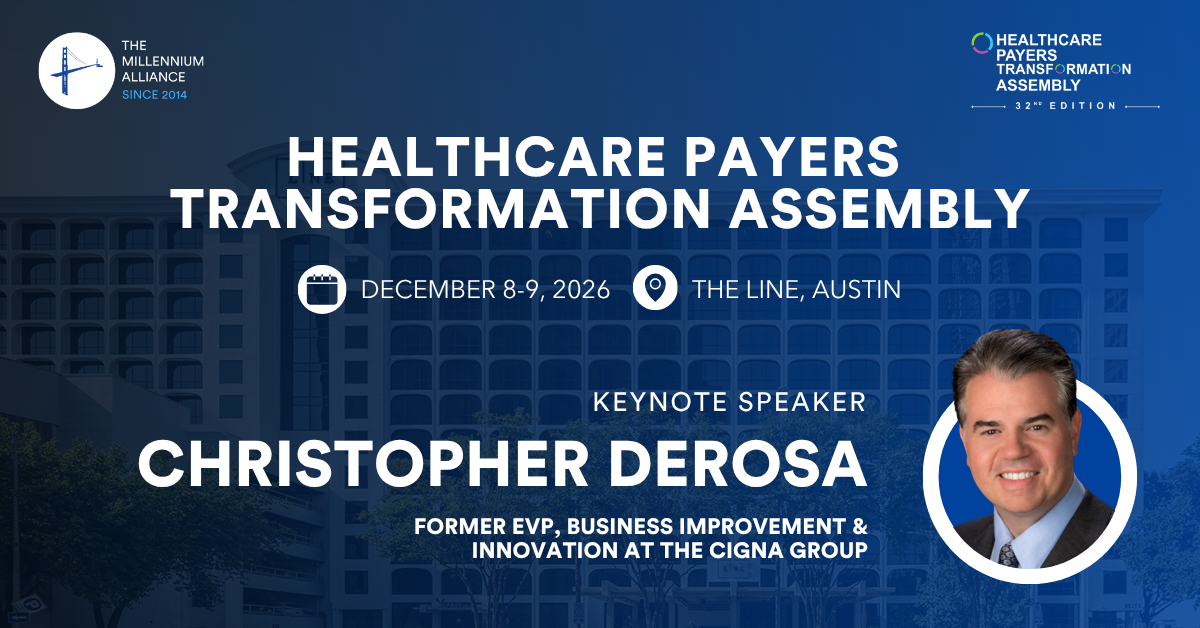
The Millennium Alliance is excited to announce that Christopher DeRosa, Former EVP, Business Improvement & Innovation at The Cigna Group, will keynote our Healthcare Payers Transformation Assembly December 8-9 at The Line in Austin.

Interested in joining this Assembly? Click here to request an invite

About Christopher DeRosa

Christopher is an executive leader with deep experience driving operational excellence, large-scale transformation, and sustainable business growth across the healthcare and insurance industries. His work centers on creating long-term value—improving performance, strengthening organizational resilience, and advancing strategic priorities that matter. He is recognized for revitalizing underperforming business units.

He excels at optimizing operations, increasing profitability, and building cultures rooted in innovation, accountability, and continuous improvement. His background spans government programs, commercial markets, national accounts, and sales effectiveness, with a proven track record of managing complex enterprises, overseeing multi-billion-dollar P&Ls, and leading organizations of more than 20K employees.

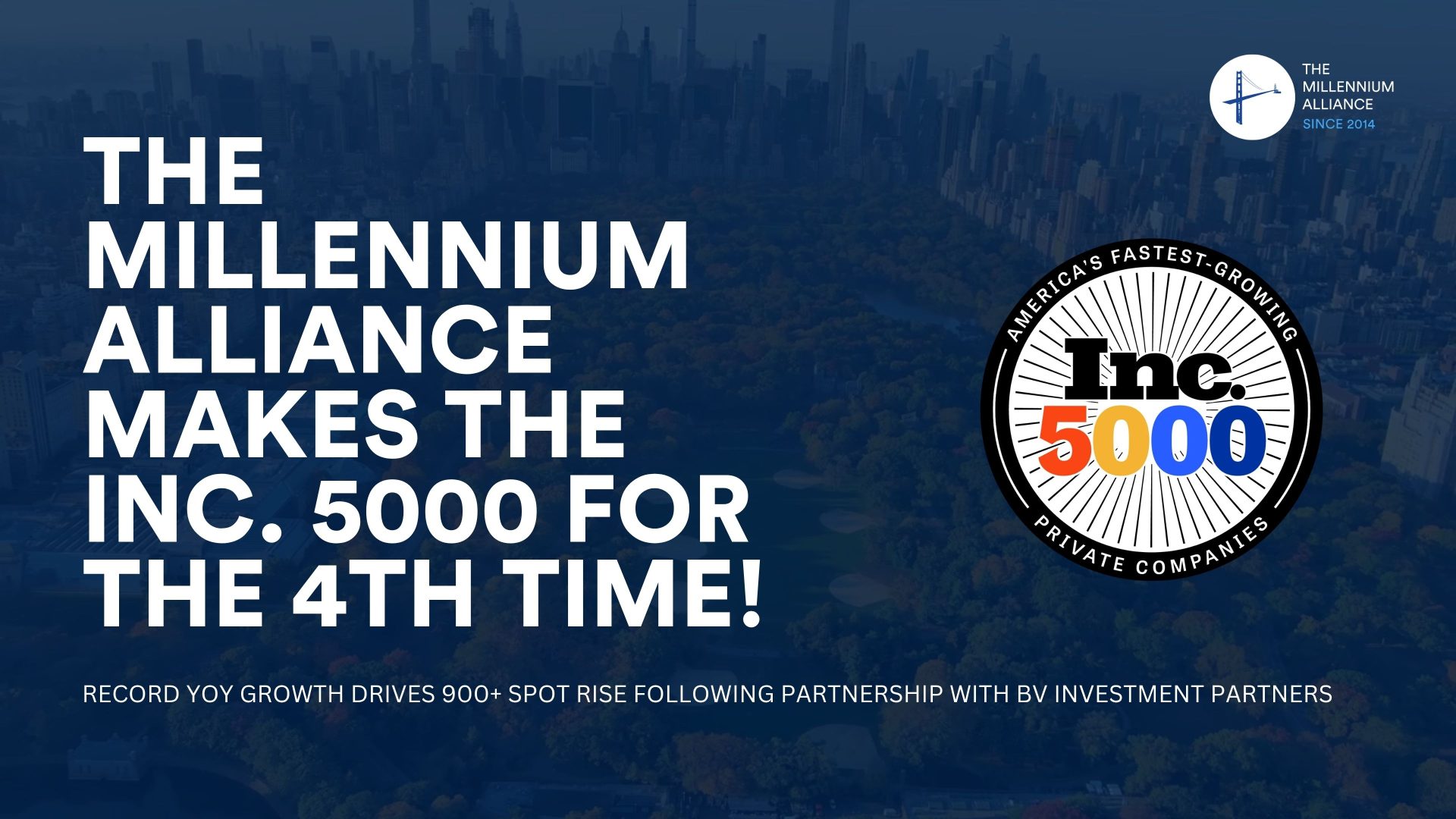
The Millennium Alliance Announces its 4th Consecutive Recognition on the 2026 Inc. 5000 list, ranking No. 1952

With impressive YoY revenue growth since 2022, the company rose over 900 spots, marking a new record success under a new partnership with BV Investment Partners.

 NEW YORK, August 11, 2026 – Inc., the leading media brand for entrepreneurs and business leaders, announced that The Millennium Alliance secured the No.1952 spot on the prestigious Inc. 5000 list, celebrating its remarkable growth and success.

“Four consecutive years on the Inc 5000 list is an incredible honor and a testament to the relentless drive of our entire team,” said Alex Sobol, Co-Founder of The Millennium Alliance. “This year is special for us as we entered a new acquisition under PE firm BV Investment Partners, developed new Assembly tracks across finance, technology, and marketing, and expanded our digital presence. Building this consistent recognition with Inc reflects not only our growth, but the trust our clients place in us every single day.”

This year’s Inc. 5000 recognizes a new class of companies redefining what growth looks like. From AI and advanced manufacturing to healthcare, consumer products, and professional services, these businesses are expanding their impact, creating jobs and proving that entrepreneurial ambition continues to fuel the U.S. economy. Among the 5,000 companies on the list, the median three-year revenue growth rate was 130%, and those companies have collectively added more than 625,000 jobs to the U.S. economy over the past three years.

For the full list, company profiles, and a searchable database by industry and location, visit https://www.inc.com/inc5000.

“Every company on the Inc. 5000 has a story of perseverance, smart decision making, and a refusal to sit still,” says Mike Hofman, editor-in-chief of Inc. “Their growth reflects more than strong financial performance – it reflects creativity, resilience, and the customer focus required to build companies that make a lasting impact. We congratulate all honorees on this significant achievement.”

Inc. will celebrate the honorees at the 2026 Inc. 5000 Conference & Gala, taking place on October 14-16 in Dallas, Texas, and will also present the top 500 in the Fall issue of Inc. magazine.

About The Millennium Alliance

Our Impact & Reach

We provide senior executives with tangible, real-world learning through a mix of curated in-person experiences and a supporting multimedia ecosystem, including:

  • High-Impact Events: Exclusive multi-day global Assemblies, ABM-focused community dinners, and one-day city sessions designed to foster meaningful connections, actionable insights, and peer-to-peer collaboration
  • Digital Leadership: Robust online platforms and premium digital properties
  • Elite Research: Collaborative projects with world-renowned academic institutions and think tanks

A Global Community
Now one of the world’s fastest-growing platforms for the Enterprise C-Suite, the Alliance serves organizations of all sizes across the private and public sectors. Headquartered in Midtown Manhattan with European operations in the heart of London, we continue to evolve as an international hub for the innovation and technology community.

Methodology
Companies on the 2026 Inc. 5000 are ranked according to percentage revenue growth from 2022 to 2025. To qualify, companies must have been founded and generating revenue by March 31, 2022. They must be U.S.-based, privately held, for-profit, and independent—not subsidiaries or divisions of other companies—as of December 31, 2022. The minimum revenue required for 2022 is $100,000; the minimum for 2025 is $2 million. As always, Inc. reserves the right to decline applicants for subjective reasons.

About Inc.
Inc. is the leading media brand and playbook for the entrepreneurs and business leaders shaping our future. Through its journalism, Inc. aims to inform, educate, and elevate the profile of its community: the risk-takers, the innovators, and the ultra-driven go-getters who are creating the future of business. Inc. is published by Mansueto Ventures LLC, along with fellow leading business publication Fast Company. For more information, visit www.inc.com.

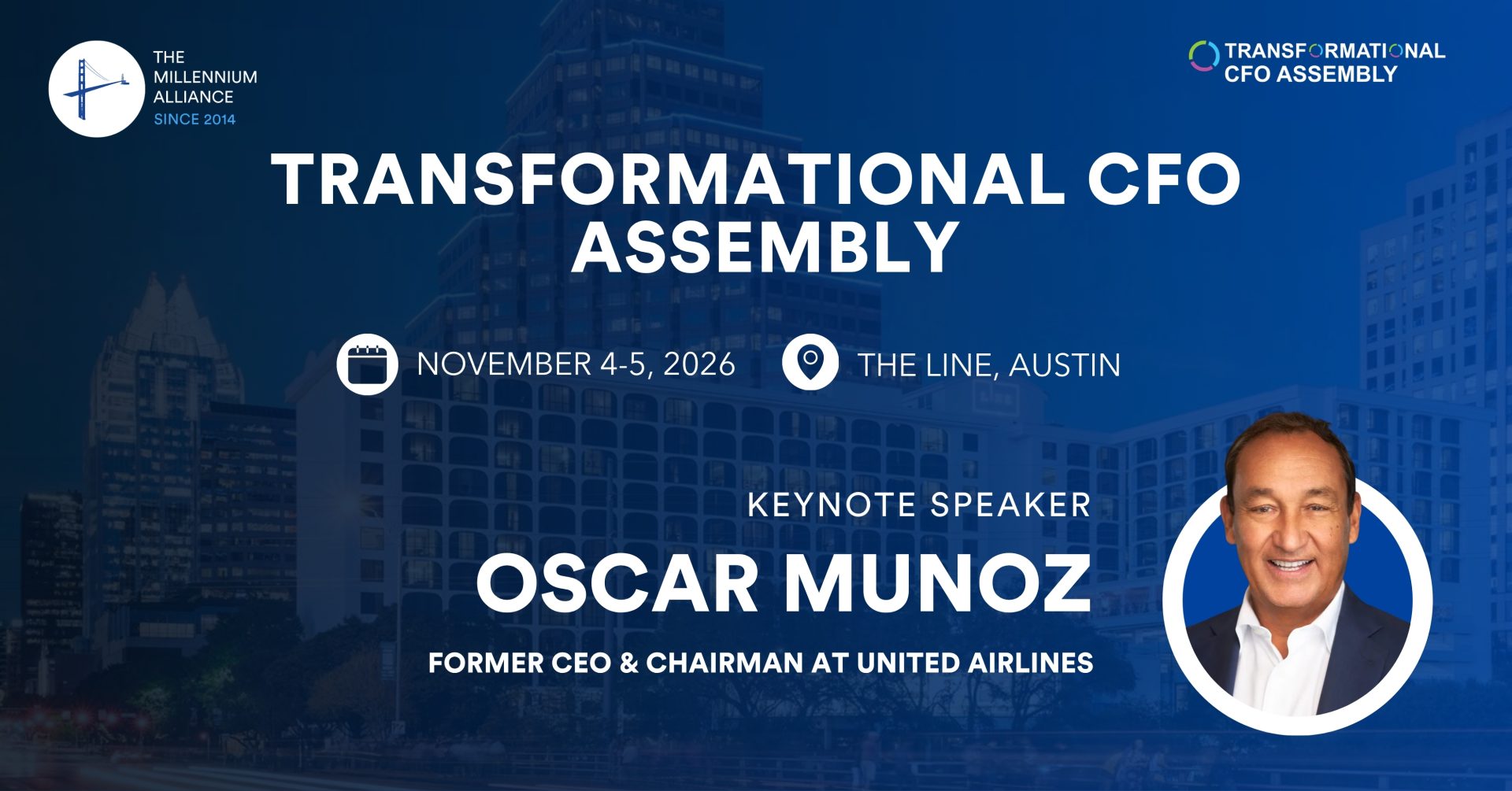
Oscar Munoz, Former CEO & Chairman at United Airlines, Keynotes Our Transformational CFO Assembly November 4-5 in Austin!

The Millennium Alliance is excited to announce that Oscar Munoz, Former CEO & Chairman at United Airlines, will keynote our Transformational CFO Assembly November 4-5 at The Line, Austin.

Interested in joining this Assembly? Click here to request an invite

About Oscar Munoz

Oscar Munoz believes that true operational success begins with putting people first, knowing that an engaged, unified workforce is the foundation for driving business growth and customer loyalty.

He is driven to build authentic, high-trust cultures, empowering employees at every level while advocating for diversity and expanding opportunities for the next generation. Having led through severe personal adversity and high-stakes corporate turnarounds, Oscar has developed a deep passion for empathetic leadership and guiding organizations through complex, high-pressure transformations.

He believes that sustainable corporate turnarounds require a balance of rigorous financial strategy and deep, trust-based labor relations. For Oscar, the frontline workforce is the ultimate differentiating factor in an organization’s long-term resilience and profitability. He emphasizes that while strategic infrastructure is vital, long-term success is only achieved when organizations invest just as heavily in their people, their culture, and their shared sense of purpose.

Business Insider: This is the hot job at SpaceX

Contributed by Business Insider

One of the hottest jobs at SpaceX right now relies on an old-fashioned skill: talking to people.

CEO Elon Musk, who also founded xAI, the company behind the chatbot Grok, has spent years saying that AI and robots will take on more of the work humans do. Yet on SpaceX’s earnings call Tuesday, he said the company is building a large enterprise sales team for the satellite internet system Starlink — work he described in distinctly human terms.

“This requires just going out there, talking to people, educating them about the currency of the Starlink system and where it’s going,” Musk said.

Musk’s comments echo what other business leaders told Business Insider: Even as AI automates parts of sales, winning complex deals still requires a human touch. Good salespeople, they said, give buyers confidence that someone will be accountable if a product or service falls short.

“Generally speaking, people still want to buy from humans,” said Brian Smith, founder of IA Business Advisors, a management consulting firm. “Even companies as large as SpaceX are selling relationships, not just a service or a technology.”

AI can help, but humans still close

AI can still play a valuable part in the sales process. For example, it can be used for customer research, preparing pitch decks, and role-playing how to triumph over rejection.

Smith said his firm uses AI to create sales scripts tailored to prospective buyers in different regions. “AI is helping to get that done faster,” he said.

The technology is likely to fall short, however, when it comes to closing a sale.

Turn expert insights into growth.

“AI is not going out for dinner with people to buy and sell,” said Alan Stein, CEO of a career-coaching firm and a former hiring manager at Google, Meta, and American Express. While AI may be able to replace some professionals, he added that “relationship-driven roles like sales are going to be less impacted.”

On Tuesday’s SpaceX earnings call, Musk said the sales team’s job will be to convince corporate and government customers that Starlink is reliable enough to serve as their primary internet provider, rather than as merely a backup.

While SpaceX is a household name that recently pulled off the largest IPO in history, it still needs to convince prospective corporate and government customers to purchase Starlink, and that’s not something AI can likely do on its own, said Alex Sobol, cofounder of the Millennium Alliance, an invite-only community for C-suite executives in North America and Europe.

“Elon’s probably not just relying on the fact that his products and technologies are received really well,” said Sobol. “I think he realizes this is probably more complicated than anything he’s put to market before, and it’s going to need a lot of people in the field talking to customers, potential customers, advocates, and skeptics.”

Palantir is shrinking its sales team
Musk’s comments contrasted with those made by another high-profile CEO this week. Palantir CEO Alex Karp wrote in a shareholder letter released Monday that his company’s sales team is getting smaller, even as its commercial business is surging.

“It must be noted that we have achieved these results with a minuscule and shrinking sales head count, another way in which we have discarded conventional wisdom in favor of our own, unique path,” Karp wrote.

Stein, Smith, and Sobol cautioned against interpreting Karp’s remarks as evidence that AI is broadly replacing salespeople. They said Palantir may be unusual because of the strong demand for its products and the nature of its customer base.

“I don’t think it’s AI. I think it’s Alex Karp’s philosophy,” said Stein.

Sobol said his own company is using AI to make its salespeople more efficient while continuing to expand the team. The Millennium Alliance has about 100 sales employees and 12 more scheduled to start in September, he said.

“We’re hiring like crazy,” he said.

About Business Insider

Business Insider is a global newsroom covering business, technology, and the economy. They help ambitious, curious people stay informed, understand the context, and get ahead.

Learn more at www.businessinsider.com

#MillenniumLive: AI Can Be the Most Auditable Actor in Your Enterprise with Thread AI

Over the past two years, enterprises have invested heavily in AI pilots, copilots, and large language models. Yet for many organizations, the journey stalls before delivering meaningful business impact. So what separates the companies successfully deploying AI at scale from those still stuck in proof-of-concept mode? We’re joined by Angela McNeal, Co-Founder and CEO of Thread AI. And In this episode, Angela shares why the industry’s conversation around autonomous AI agents may be getting ahead of enterprise reality, why governance and control aren’t barriers to innovation but the foundation for it, and how Thread AI is helping organizations orchestrate AI systems that are reliable, secure, and ready for production.

Listen on Spotify, Apple, Amazon Music

About Thread AI

Thread AI is an AI infrastructure company founded by Angela McNeal and Mayada Gonimah, former Heads of AI/ML Product and Engineering at Palantir Technologies. Through their work, they identified an infrastructure gap preventing enterprises from implementing AI in critical production operations.

Our composable AI orchestration infrastructure, Lemma, enables regulated enterprises to implement AI workflows and agents in mission-critical, high-stakes operations. We empower AI innovation leaders and engineering teams to stop settling for rigid, off-the-shelf applications that cannot adapt to their complex, proprietary workflows, or sinking massive amounts of time and capital into building custom AI infrastructure from the ground up.

Our drag-and-drop building blocks and SDK enable teams to rapidly operationalize their purpose-built workflows at the speed of off-the-shelf software with the flexibility of a custom build. Lemma enables technical and non-technical builders to deploy AI safely within defined guardrails the organization trusts, with the full reliability, governance, and control needed for production-grade, scalable AI.

To learn more, visit threadai.com

#MillenniumLive: The AI Era Creator Commerce Playbook with Later

Consumers increasingly discover products through creators—and AI-powered search engines have surfaced as trusted voices – and could be leading the way brands earn attention and drive purchases. With change always coming so fastJoining us is Nicki Seaborn, Head of Creator Product at Later, where she helps some of the world’s leading brands build creator strategies that don’t just generate engagement—they drive measurable business outcomes. From influencer partnerships and affiliate programs to creator commerce and AI’s growing role in discovery, Nicki is at the forefront of helping marketers adapt to how people actually shop today. In this conversation, we’ll explore why AI search is making creator marketing more important than ever, how leading brands are evolving their creator programs, the biggest mistakes even experienced marketers still make, and what CMOs need to understand as creator content becomes a key part of the customer journey. We’ll also look ahead at the future of creator commerce and the mindset shift Nicki hopes every marketer takes away from her upcoming talk in Nashville.

Listen on Spotify, Apple, Amazon Music

About Later

Later is the leading influencer marketing and social partner built on insight, not guesswork. We help brands choose the right creators and launch campaigns with confidence, backed by intelligence you can trust and experts who know how to make it work.

To learn more, visit later.com

Beyond Campaigns: Why Trust Is Becoming Enterprise Marketing’s Greatest Competitive Advantage with Shootsta

Contributed by Shootsta

Enterprise marketing has spent the past two decades optimizing for attention. The next decade will belong to organizations that optimize for trust.

Artificial intelligence has fundamentally changed the economics of content creation. Marketing teams can now generate articles, social posts, videos, personalized outreach, and campaign assets at a speed and scale that would have been unimaginable only a few years ago. What once required weeks of planning and significant creative investment can now be accomplished in hours.

Yet one constraint has remained unchanged.

While organizations have dramatically increased their capacity to produce content, their audiences have not developed a greater capacity to consume it. Customers, employees, partners, and investors still have the same finite amount of attention. Every organization is publishing more, but no one is consuming proportionately more. The result is an environment where content is abundant, attention is scarce, and standing out has never been more difficult.

This is the Trust Economy.

As artificial intelligence democratizes content creation, competitive advantage shifts away from the ability to produce more and toward the ability to inspire confidence. Products can be copied. Technology can be matched. Campaigns can be replicated. Trust cannot.

The evidence is already emerging. According to Edelman’s 2025 Brand Trust Report, 80% of people trust the brands they use, a higher level of trust than they place in business, government, media, NGOs, or even their employer. At the same time, research from LinkedIn, Bain & Company, and NewtonX found that 81% of B2B purchases were won by vendors already known across the buying group before the buying process began. The implication is clear. Competitive advantage is shifting from producing more content to building greater confidence in the people and brands behind it.

The implication is profound. Enterprise marketing is no longer competing simply for attention. It is competing for belief. And organizations that consistently earn belief will ultimately earn something far more valuable: trust.

Beyond Campaigns

Most enterprise marketing organizations excel at creating moments.

Product launches, customer conferences, demand generation campaigns, analyst briefings, and major brand initiatives are highly visible, carefully orchestrated, and often become the primary measure of marketing success. They play a critical role in shaping market awareness and driving commercial momentum.

But campaigns alone rarely determine whether an organization is trusted.

Trust is formed in the thousands of interactions that happen before, after, and between those defining moments. It grows when executives communicate with transparency during periods of uncertainty. It strengthens when subject matter experts consistently educate rather than promote. It deepens when employees hear directly from leadership, and when sales and customer success teams demonstrate expertise instead of relying on generic personalization.

In other words, organizations are not judged only by what they say during campaigns. They are judged by how they communicate every day.

The enterprise teams building the strongest brands recognize that communication is no longer just a marketing function. It is an organizational capability that shapes reputation, customer relationships, employee engagement, and long-term commercial performance.

That requires a different approach.

Rather than viewing communication as a series of isolated campaigns, leading organizations are building a balanced communication model that combines three complementary motions.

Peak creates moments that earn attention. Product launches, strategic campaigns, investor announcements, and major events generate visibility and signal intent.

Pulse creates a consistent rhythm of communication between those moments. Executive updates, customer education, thought leadership, employee communications, and ongoing storytelling ensure an organization remains relevant long after a campaign has ended.

Presence is created when leaders and subject matter experts become visible through authentic, consistent communication. By sharing expertise, explaining decisions, and engaging directly with customers, partners, and employees, they strengthen the credibility of the organization itself.

Together, these three motions transform communication from a series of marketing activities into a continuous engine for building trust.

Peak earns attention. Pulse develops belief. Presence sustains trust.

In the Trust Economy, organizations that invest only in Peak will always be competing for the next moment of attention. Organizations that master all three create something far more enduring: trust that compounds over time.

Why Video Has Become a Strategic Capability

The Peak, Pulse, and Presence framework explains what organizations need to build. The next question is how.

This is where video has become strategically important.

Video is often evaluated through engagement metrics such as views, watch time, and click-through rates. While these remain useful measures, they underestimate its greatest contribution to enterprise communication.

The greatest value of video is not higher engagement. It is higher belief.

In an environment where artificial intelligence can generate persuasive written content in seconds, organizations need communication channels that reinforce authenticity rather than simply increase output. Video allows customers to hear directly from a CEO explaining a strategic decision. It enables subject matter experts to simplify complex ideas with confidence. It helps employees connect with leaders as people, not just titles. In doing so, it communicates qualities that are difficult to replicate through text alone: expertise, transparency, empathy, and conviction.

It is no surprise that more than 90% of marketers report that video delivers a positive return on investment, according to Wyzowl’s State of Video Marketing. Yet perhaps its greatest return never appears on a dashboard. It is the confidence video creates among customers, employees, investors, and partners.

One organization that demonstrates this well is DUAL. Rather than reserving video for major campaigns, DUAL embedded it across executive communication, customer education, thought leadership, employee engagement, and customer stories. Strategic campaigns continued to create impactful Peak moments, while ongoing communication established a consistent Pulse and leaders strengthened their Presence through authentic, visible communication.

The outcome was not simply more video.

It was stronger credibility, deeper relationships, and a communication model that continuously reinforced trust across every stakeholder interaction.

That is the shift many enterprise organizations are now making. They are no longer asking, “How do we produce more videos?”

They are asking a far more strategic question.

How do we build an enterprise capability that enables trusted communication at scale?

Building Enterprise Video Capability

For most enterprise organizations, the challenge is no longer recognizing the value of video. It is operationalizing it.

Demand is growing across every function of the business. Marketing needs always-on content. Sales teams are incorporating personalized video into account-based selling. Customer success is using video to strengthen onboarding and adoption. Internal communications, learning and development, human resources, and executive leadership all increasingly rely on video to communicate more effectively.

Yet many organizations continue to support that demand with an operating model designed for occasional production rather than continuous communication.

The result is predictable. Creative teams become bottlenecks. High-value opportunities are delayed or abandoned. Leaders and subject matter experts want to communicate more frequently but lack the tools, confidence, or governance to do so at scale.

Leading enterprises are responding by changing the question.

Rather than asking, “How do we produce more videos?”, they are asking, “How do we build Enterprise Video Capability?”

The distinction is more than semantics.

Producing video is an activity. Enterprise Video Capability is an operating model.

It enables organizations to create trusted, high-quality communication consistently, while maintaining governance, brand integrity, and creative standards. More importantly, it enables Peak, Pulse, and Presence to operate together as a coordinated system. Campaigns continue to earn attention. Leaders become more visible. Subject matter experts educate continuously. Communication evolves from a collection of projects into a strategic capability that compounds trust over time.

Over the past decade, this has become one of the clearest lessons we’ve observed at Shootsta. The organizations achieving the greatest impact are rarely those producing the most videos. They are the ones that have embedded video into the way they communicate, making it an integral part of how they build relationships with customers, engage employees, and develop confidence in their brand.

Enterprise marketing has spent years investing in technologies that make communication faster.

The next competitive advantage belongs to organizations that make communication more trusted.

Where Do You Start?

Building Enterprise Video Capability is not about producing more content. It is about creating the governance, workflows, and operating model that enable trusted communication to scale across the business.

To help enterprise leaders on that journey, Shootsta has developed the Enterprise Video-First Communication Strategy Guide. Rather than focusing on production techniques, the guide explores how leading organizations operationalize Peak, Pulse, and Presence across marketing, sales, customer success, executive leadership, internal communications, and learning and development. It provides practical guidance for building communication capability that strengthens trust over time.

→ Download the Enterprise Video-First Communication Strategy Guide

Understanding best practice is only the first step. Understanding your organization’s current maturity is equally important.

That’s why we’ve also developed the Enterprise Video Maturity Assessment, a short executive diagnostic that evaluates how effectively your organization is building Enterprise Video Capability across governance, adoption, scalability, leadership communication, and strategic alignment.

Participants receive an immediate maturity assessment with practical recommendations for improvement, while contributing anonymized data to Shootsta’s forthcoming Enterprise Video Capability Benchmark Report. Together, these resources are designed to help enterprise leaders understand not only where they are today, but what it will take to build trusted communication as a lasting competitive advantage.

→ Take the FREE 3-Minute Enterprise Video Maturity Assessment

Conclusion

Artificial intelligence will continue to transform how enterprise organizations create content. It will improve efficiency, accelerate production, and make communication more accessible than ever before. Those are important advances, and every enterprise should embrace them.

What artificial intelligence will not change is how people decide whom to trust.

Trust is earned through authentic leadership, consistent communication, demonstrated expertise, and meaningful human connection. Technology can amplify those qualities, but it cannot replace them.

That is why the future of enterprise marketing will be defined not by the volume of content organizations create, but by the confidence they inspire. The enterprises that outperform over the next decade will be those that balance Peak moments that earn attention, Pulse communication that develops belief, and Presence that sustains trust long after campaigns have ended.

In the Trust Economy, trust is no longer simply a brand outcome.

It is a business capability.

And it may become the last truly defensible competitive advantage.

About Shootsta

Shootsta helps enterprise organizations build Enterprise Video Capability, combining enterprise technology with a global team of creative professionals to make trusted communication scalable.

Unlike traditional production agencies or software-only platforms, Shootsta offers a hybrid model designed for modern enterprises. Shootsta Pro enables employees to capture authentic content using their own devices, while professional editors deliver polished, brand-compliant videos, typically within 48 hours. For larger strategic initiatives, Shootsta Premier provides end-to-end creative strategy, production, animation, and campaign support.

Trusted by many of the world’s leading enterprise organizations, Shootsta helps teams communicate consistently, authentically, and at scale.

To learn more, visit shootsta.com.
#MillenniumLive: People Models & Populations 2.0: How Human AI Is Transforming Product Innovation with Vurvey Labs

As organizations increasingly rely on AI to inform product development, marketing, and customer experience, we bring you the organizations that are truly delivering an impact. Today, we’re joined by Chad Reynolds, CEO and founder of Vurvey Labs, a company removing the barriers for human collaboration and helping artificial intelligence better understand how people think, feel, and make decisions. Vurvey is certainly taking a different approach by simulating human behaviors, combining AI with human insight to help businesses test ideas and make more informed decisions before going to market. We’ll explore Chad’s entrepreneurial journey, why he believes today’s AI is missing a critical understanding of people, and how Vurvey’s latest innovation, Populations 2.0, is enabling organizations to simulate consumer responses at scale. We’ll also discuss how companies are putting this technology to work today, and where Chad sees Human AI and People Models evolving over the next several years.

Listen on Spotify, Apple, Amazon Music

About Vurvey Labs

We empower enterprises to build insightful ecosystems with custom AI solutions, and we connect individuals with AI companions to unlock productivity and join a thriving community of innovators. Where AI works for you, not instead of you.

To learn more visit: https://vurvey.com/

The Complete Guide to Data-Driven MHE Fleet Management with UgoWork

Contributed by Ugowork

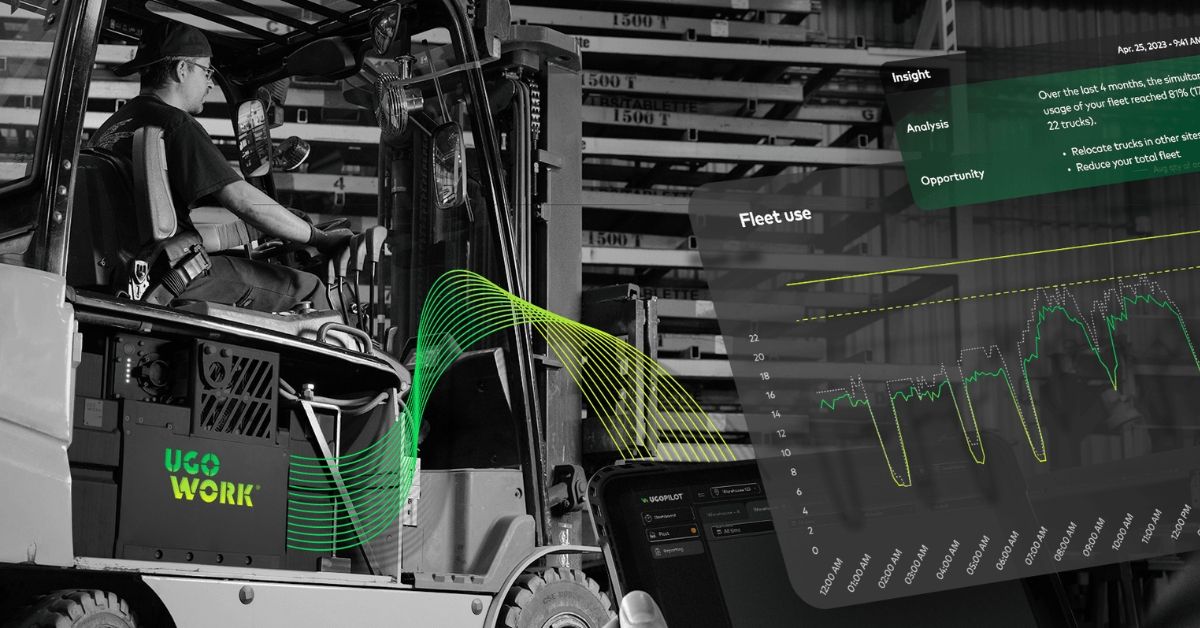
Our partners at UgoWork’s new Complete Guide to Data-Driven MHE Fleet Management puts structure on material handling costs that most operations carry without itemizing.

Here’s what it unpacks:

A smarter fleet is often a smaller one: Roughly a quarter of MHE fleets carry trucks they don’t actually need. The guide shows how connected lithium-ion batteries surface the utilization data that makes right-sizing possible without losing capacity.

Energy you can finally attribute: Most utility bills aggregate the waste. Smart battery systems track kWh per truck, per shift, and per operator, exposing a per-truck operator delta that can exceed $5,000 a year.

Maintenance you can plan, not react to: Unplanned battery failures cost $2,000 to $5,000 per incident. Smart battery systems predict them months in advance, moving procurement from emergency to scheduled.

A readiness check before any pilot: The guide includes a nine-question audit that flags whether a data-driven transformation is the right move for your operation right now.

Download the guide here.

About UgoWork

UgoWork is on a mission to eliminate energy waste in the material handling industry. They engineer smart lithium-ion forklift batteries and charging infrastructure for the real-world demands of high-throughput warehouses. Beyond hardware, Ugowork addresses every energy challenge—power consumption, grid constraints, asset life, and large-scale fleet transitions. Vertically integrated from manufacturing to deployment, service, and training, they deliver plug-and-play integration with your fleet and facility systems. UL Listed and OEM-approved, their solutions are safe and the easiest to use. From Québec, Canada, Ugowork powers some of the largest S&P 500 and Fortune 500 operations across North America—making lift-truck energy one less thing to worry about.

To learn more, visit ugowork.com.

Defensible AI: The GRC Leader’s Guide to Verify, Audit, and Trust with Mitratech

Contributed by Mitratech

Only 12% of organizations with a dedicated AI governance body describe those structures as mature and proactive. If yours is in the other 88%, that gap is where your regulatory audit exposure lives.

If you’re responsible for making AI governance functional, this guide covers:

  • Why most AI governance structures fail under regulatory examination, and what functional governance actually requires
  • The four structural gaps that make GRC AI programs indefensible, and how to identify which apply to yours
  • What connected GRC data architecture makes possible in practice: audit traceability, named accountability, and decisions that hold up when regulators arrive
  • The verify, audit, and trust framework for closing those gaps before examiners come looking

Download the guide here to get started.

About Mitratech

Mitratech is a global leader in Governance, Risk, and Compliance (GRC) software, trusted by more than 8,300 organizations across 75 countries. Our GRC platform unifies people, processes, and data to deliver risk intelligence organizations can trust—enabling faster, better-informed decisions at every level.

Combining deep GRC expertise with responsible, AI-driven automation, Mitratech helps organizations proactively manage enterprise, cyber, IT, third-party, ESG, continuity planning, ethics, and regulatory risk at scale. Configured to each organization’s needs and built to evolve with complexity, Mitratech GRC reduces fragmentation, streamlines compliance, and transforms risk management into a resilient, insight-driven capability that supports confident, future-ready performance.

Innovate now by visiting: www.mitratech.com